
Newsletter
Sign up for our newsletter for information on our latest products and promotions.
Sign up for our newsletter for information on our latest products and promotions.

Please confirm that you are of legal age
to purchase alcohol in your region.
You currently have an active checkout session
open already, would you like to clear it?


1257 Kensington Road NW
1 (403) 283-8000 / atyourservice@kensingtonwinemarket.com
$184.99
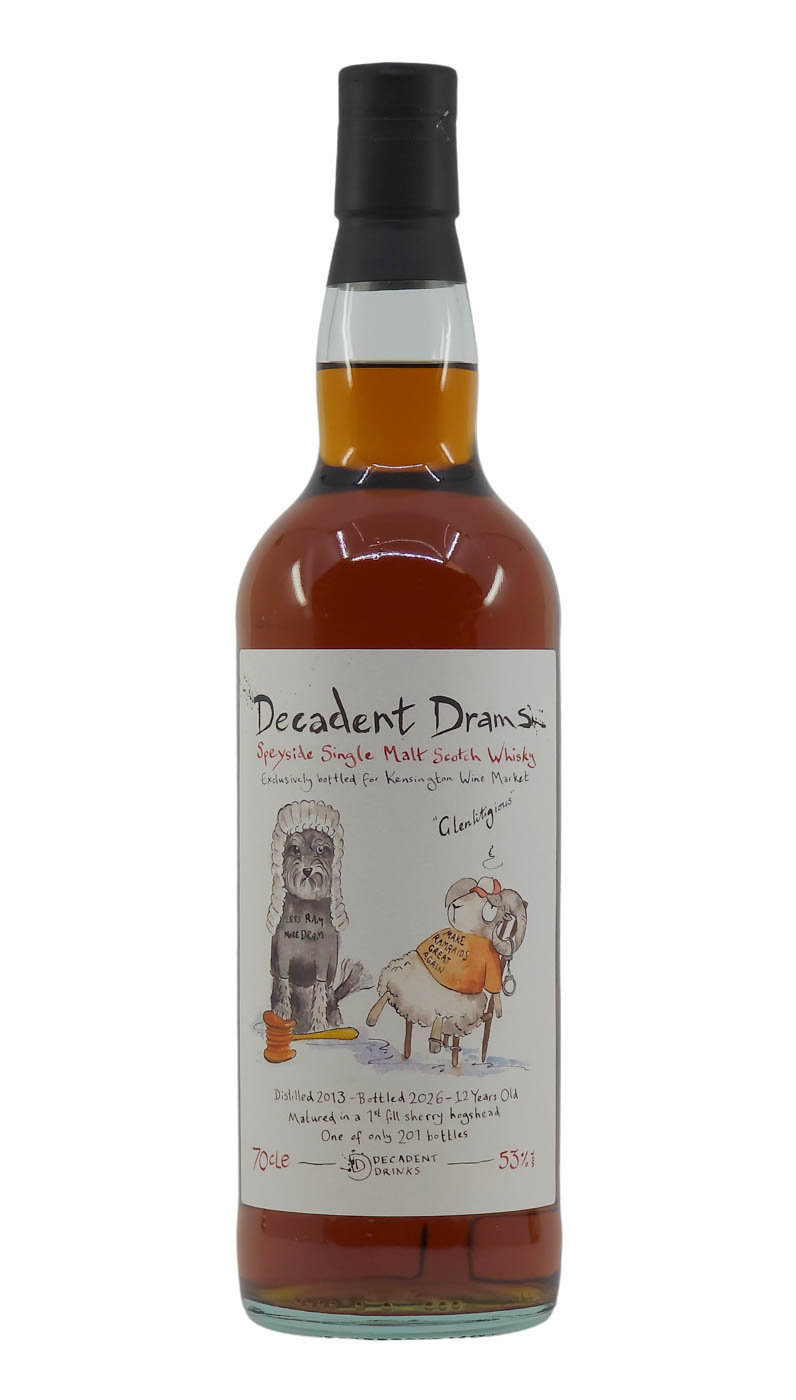
This KWM exclusive bottling of Glenlitigious (cough: "Glenfarclas") is from a 2013 vintage PX sherry seasoned American oak hogshead, bottled after 12 years at 53%. Note this is not cask strength, rather it was diluted to 53%, partly because Angus felt it was more drinkable, and partly to keep the price down. While we generally go for cask strength, Decadent Drinks frequently dilutes some of their bottlings (as do some others) a few degrees to an ABV they feel best suits the individual whisky.
The Glenlitigious labels from Decadent Drams are for bottlings of Glenfarclas, a famously litigious distillery, who doesn't appreciate independent bottlers identifying it by name. Our Glenlitigious label features Walter in a powdered wig sitting in judgment over a ram stuffy, his paw on a squeaky toy gavel, and his tail playfully wagging. This is a not so subtle nod at our last KWM exclusive Glenfarclas bottling, the Door Crasher Edition, which featured a Trojan ram on wheels speeding towards the front of our shop. That whisky was bottled to mark the 2nd anniversary of the Infamous Dodge Ram incident of February 11th, 2022, when a stolen pickup truck was employed to enter our store outside business hours.
Angus' Back Label Text
"Walter is a good judge, both of character and casks. This richly sherried, Speyside single malt, from a rather notoriously prickly family-owned distillery, is a classical example of the make and got Walter's tail wagging approvingly. We've called it 'Glenlitigious', it's suitable for wee dogs and Canadians, but no ram raiders allowed!"
700 mlMy Tasting Note
Nose: dark, rich, decadent, and spicy with syrupy sherry tones; dark chocolate, treacle sauce on sticky toffee pudding, and Ferrero Roche; figs in honey, candied orange, and grilled prosciutto wrapped dates; leather, tobacco, and earthy spice: fennel, clove, and licorice.
Palate: big, rich, and decadent with more syrupy sherry; dark chocolate acai berries, sticky toffee pudding with treacle sauce with vanilla bean ice cream, and Ferrero Roche; barrel aged maple syrup and Rob Roy cocktail; more figs in honey, mince meat (with candied orange), and grilled prosciutto wrapped dates; the wood spices build: more fennel, Dutch licorice, and clove; Cuban cigars and polished new leather.
Finish: long, dark, rich, and decadent with firm earthy spice; mince meat and blueberry pies, in buttery crusts, warm from the oven with a side of vanilla bean ice cream.
Comment: this is a superb Glenfarclas, more sherried than we typically see from comparably aged OBs; we worked hard with our partners to make this one work because the cask was simply sublime; despite the sherry forward profile, the oak has not hidden Glenfarclas' signature style.
The following was written by Andrew Ferguson for Celtic Life in 2018:
Like most of the Scottish distilleries to open in the 18th and 19th centuries, Glenfarclas was a farm before becoming a distillery. Whisky-making requires both barley and a good supply of clean water, so it is not surprising that most of Scotland’s distilleries are found in rolling barley fields at the foot of the country’s wild mountains.
The connection between whisky and agriculture is vital; barley was an important feed stock for cattle, but it is very hard for them to digest it in its raw form. However, when it is malted, milled and mashed (to remove the sugars for fermentation into beer), what results is a slightly sweet, protein-rich cattle food. What farmers discovered over time, though, was that whisky making was far more profitable than farming or cattle rearing.

Although owner Robert Hay took out a license to distill at Glenfarclas in 1836, no one knows exactly when his farm started producing whisky. As with many distilleries at that time, the founding date does not always indicate when the facilities first started producing whisky, but rather when they were caught distilling illicitly and forced to apply for a license. One clue to the distillery’s origins is a watercolour painting from 1791, which still hangs in the location today. In the painting, the farm has a smokestack, vessels that look a lot like wormtubs (for condensation), and barrels strewn all over the yard. It also sits clearly at the foot of Ben Rinnes, the tallest mountain in the area. Most tellingly the words “Glenfarclass Disty” are scrawled in the bottom right hand corner.
The story of Glenfarclas starts to get interesting in 1865, when the distillery was acquired by the Grant family following the death of Robert Hay, for the sum of £511.90. For the next 152 years, six generations of the Grant family have run and managed the distillery. Curiously, since the purchase, all five of the chairmen have been named either John or George. The current chairman is John L.S. Grant, and his son - and successor - is named George. This unbroken chain of Johns and Georges may have run its course though, as George has two daughters, and to the best of my knowledge neither is named John or George. Glenfarclas is a stubbornly independent firm, and not without reason.

They were early partners with Pattison Elder & Co., a firm run by a pair of “reckless” and flashy brothers from Leith. Pattison Elder & Co. was the whisky industry’s ‘Enron’ of their day, building an empire on promises, lies, cheap credit, and IOUs. When they spectacularly collapsed in 1898 they took most of the industry with them, including - very nearly - the Glenfarclas Distillery. The Grants barely held on to their distillery, and it would take 15 years of hard work to recover their position. Thus, a “Spirit of Independence” was born.
The second half of the 20th century saw the distillery transition from producing whisky for blends to focusing on single malts. Glenfarclas pioneered the concept of Cask Strength whisky in 1968, with the release of their 105˚ Cask Strength which is bottled at 60 per cent (105˚ British proof). The whisky is still available today, and is created by marrying casks until they hit the magic number of 60 per cent abv. Most distilleries lose 1 to 2.5 per cent of their maturing whisky to evaporation each year - what we call “the angels' share.” Glenfarclas loses less, only 0.5 per cent, owing to both a local microclimate and a focus on the use of larger Sherry Butts for maturation. The distillery also fills its barrels at a higher proof than their peers, as it is not reliant on trading casks for blends at a standardized strength. As the fourth Grant to own Glenfarclas, the late George S. Grant was allegedly fond of saying, “we are not in the business of maturing water.”

Glenfarclas has a depth of maturing whisky stocks which is the envy of the entire Scotch whisky industry. They have released single casks under their “Family Cask” range for every year up to, and including, 1952. The company’s business plan has always been to lay down as much whisky as they can, even when times are tight. Business will eventually pick up again, and if there is no stock then there won’t be anything to sell.
Glenfarclas has survived 22 recessions, the Great Depression, and the Pattison Whisky Crash. They will also likely survive the day when someone other than a John or George takes the helm as chairman.
The distillery is located just off the A95, about 5 minutes’ drive from the town of Aberlour, in Scotland’s stunning Speyside region. The facility offers tours daily, including a ‘Five Decades’ tour for £100, which includes the tasting of a whisky from every decade between 1960 and the 2000s. If you can’t make it to Glenfarclas you should be able to find their whisky. The 105˚ Cask Strength is excellent value at $84. Try it neat before you add any water to it, as it is rich, fruity and spicy, though not rough. The 15 Year, $90, is their benchmark sherried whisky and flagship single malt. If you really want to treat yourself, find a bottle of the 40 Year - at $1,100 it might seem dear, but it is lovely, layered, very fruity, and great value for its vintage.
$219.99
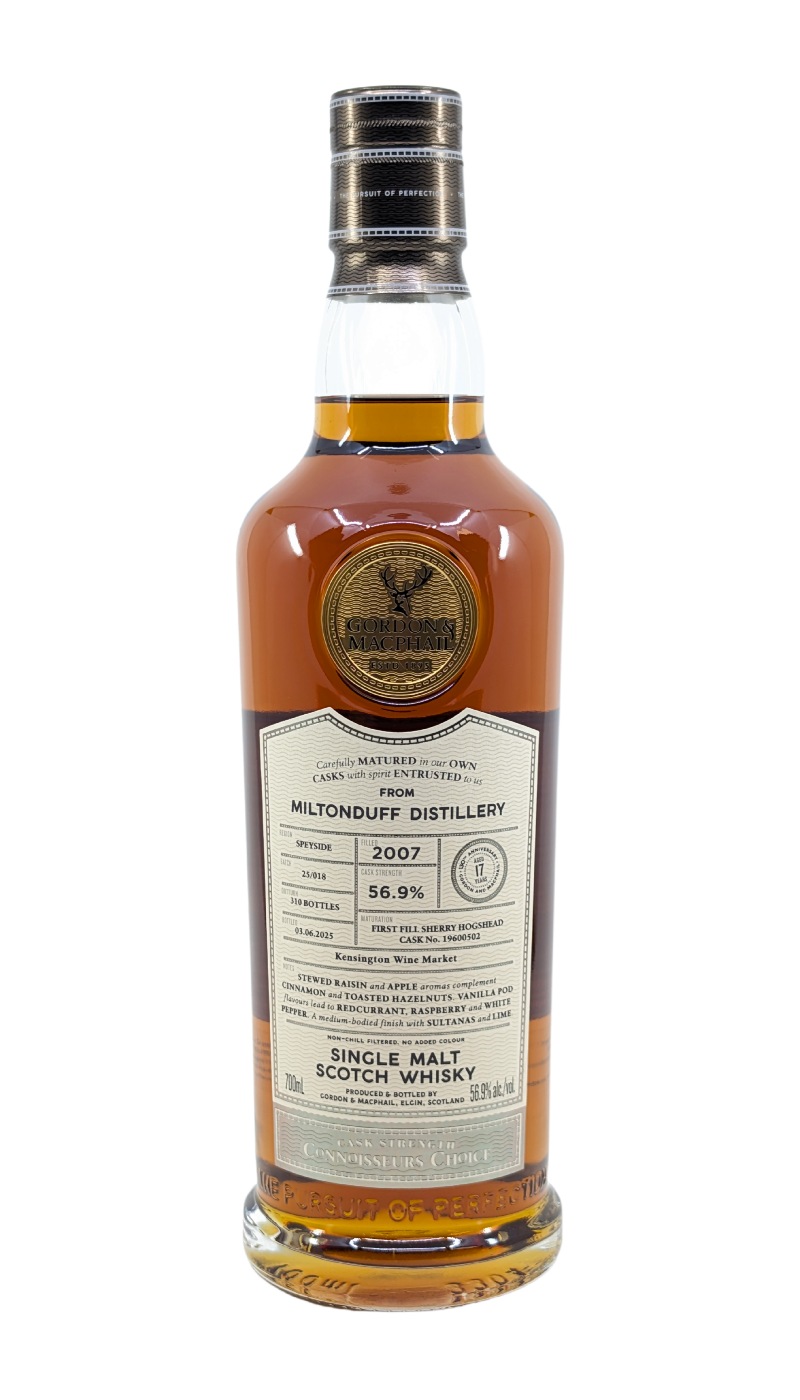
This G&M Miltonduff was selected and bottled exclusively for Kensington Wine Market. Distilled in 2007, this Miltonduff was matured for 17 years in a first fill ex-Sherry hogshead (Cask #19600502) before being bottled at a cask strength of 56.9%
This is only our 2nd ever KWM single cask of Miltonduff, but it is our 16th KWM single cask bottling from Gordon & MacPhail!

$169.99
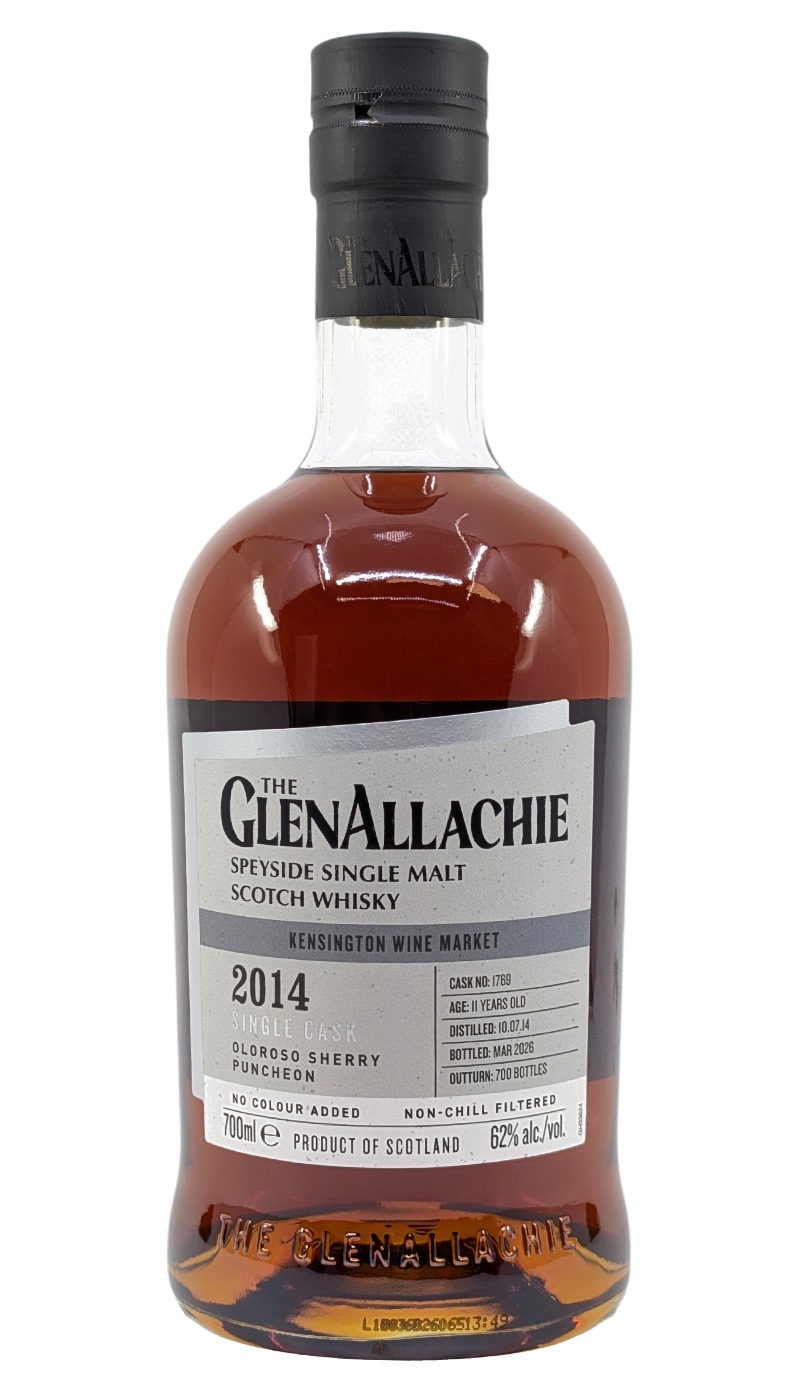
Our 2nd KWM exclusive single cask from GlenAllachie is a 2014 vintage Oloroso Sherry Puncheon, bottled after 11 years at 62%. This is a sherry bomb, with finesse, that will delight Billy Walker fans, and anyone who likes a proper sherried dram. Despite the punchy ABV it is very drinkable at natural strength.
We can probably assume this whisky was re-racked by Billy and his team at some point after they acquired the distillery from Pernod Ricard. First, the ABV, is a clue that this was put into its original cask at still strength, rather than the industry standard 63.5%, presumably to save on casks. Pernod almost certainly wasn't putting GlenAllachie into top of the line sherry cask in the mid-2010s when demand and pricing for sherry casks was high.
The Billy Walker secret sauce, typified by his time running GlenDronach, is to re rack maturing stocks into more active casks. The Outturn, 700 bottles, which is a lot from a single cask, even a puncheon which can range from 500-700 litres in size, is another clue that this was likely a finishing cask? Probably, but even if true, the reality is the whisky very likely spent more time in the Puncheon, than it would have in the casks it started out in.
Regardless, the result is an excellent GlenAllachie sherry cask, and a bottling we are thrilled to have our name on!
$269.99
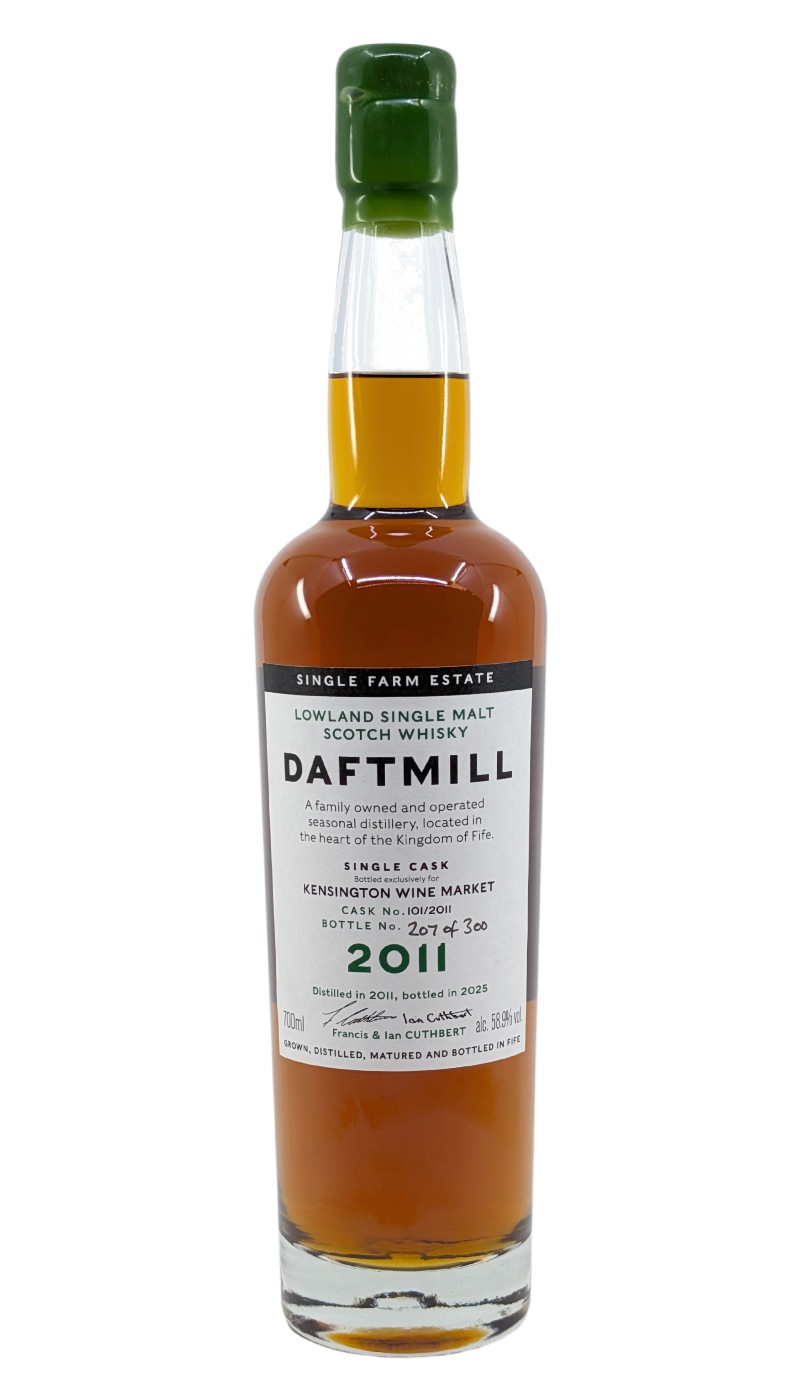
Our second ever, KWM exclusive Daftmill Cask is a 13 year old, matured in a First Fill Oloroso Butt (filled in 2011), before bottling at 58.9%. Daftmill is one of Scotland's smallest distilleries, it is literally a one-man show, and it only fills about 100 casks a year. Of the 100, the vast majority are ex-Bourbon Barrels, just a handful of sherry butts are filled each year, so it is a real honour to have been given the opportunity to bottle one. This is the first sherry matured Daftmill to come to Canada!
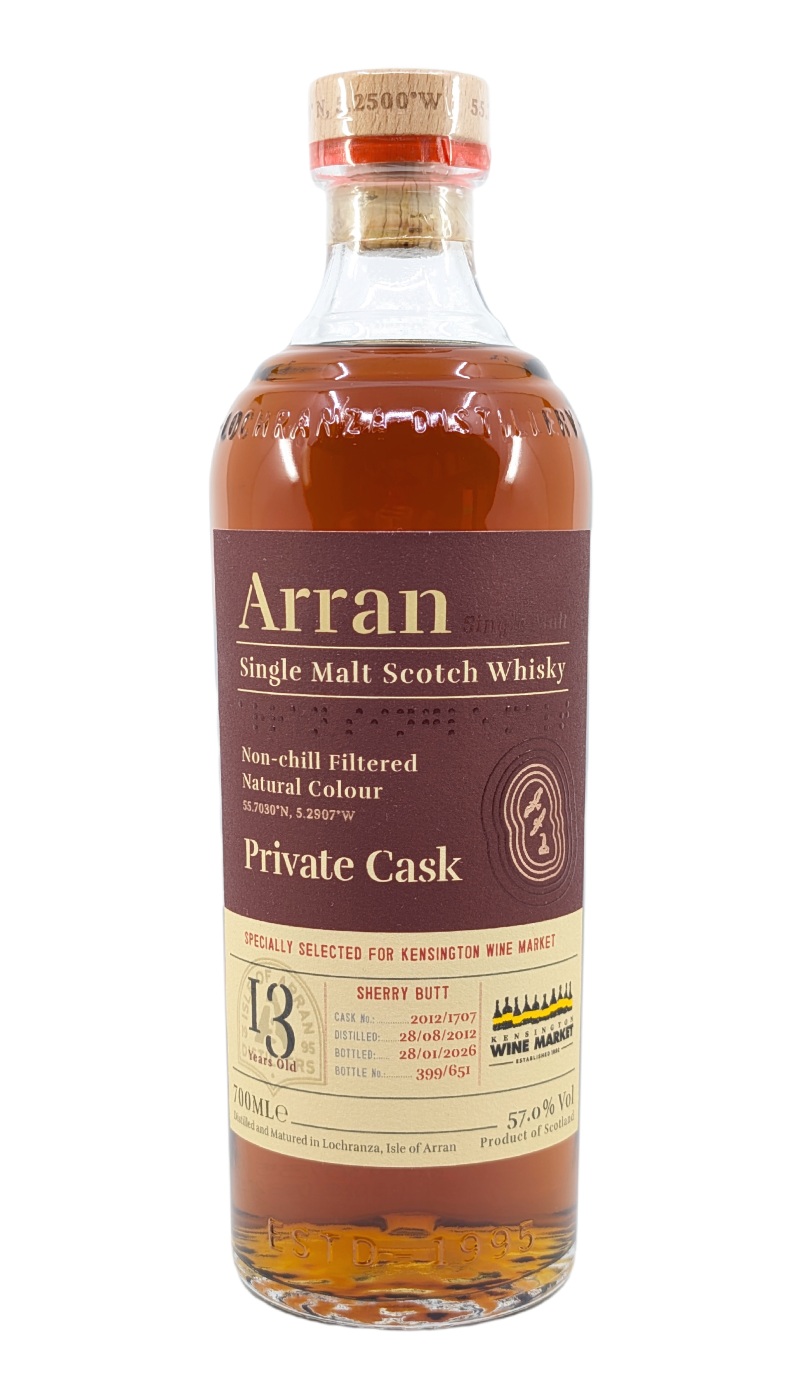
$159.99
This is our 14th KWM exclusive single cask from Arran. This 2012 vintage single malt was matured 13 years in a Sherry Butt, Cask #1707. 651 bottles in total, bottled at cask strength of 57%.
Andrew's Words from the Rear Label
"Kensington Wine Market’s relationship with Isle of Arran Distillers goes back more than 20 years, to the early 2000s. In that time, we have bottled more single casks from Arran (Lochranza) than we have from any other distillery. Arran has remained one of our favourite whiskies over the last 20 years owing to the quality of its bottlings, and the value they continue to offer to customers. This is our 14th KWM exclusive cask of Arran, and it should be arriving just in time to celebrate our 34th Anniversary. But we dedicate this one to our friends at Isle of Arran, who recently celebrated their 30th Anniversary!”